Typhoon Days in Taiwan: How Closures Work, What to Do and What We'd Stock Up On
By Raytio Ray
Typhoon day in Taiwan, what to do: how work and school closures are decided and announced, your rights if your employer says come in, and a simple prep list.
The short answer
A typhoon day (颱風假) is a day when your city government suspends work and classes because a storm is close. In Taipei, the mayor decides, usually announces it between 7pm and 10pm the night before, and posts it on the central government's closure page. If your city, the city you work in, or the area you commute through is closed, you can stay home, and your employer cannot mark you absent or cut your attendance bonus. For a typhoon day in Taiwan, what to do is simple: stock up the day before, stay indoors at the peak, and stay out of the mountains and off the coast for a day or two after.
Typhoons are routine here. According to the Central Weather Administration, about three to four typhoons hit Taiwan in an average year (3.2 on the long-run average), and about 70% of the season's storms form between July and October. Most pass as a day of heavy rain and wind. A few are genuinely dangerous. The rest of this guide is what we tell people before their first one.
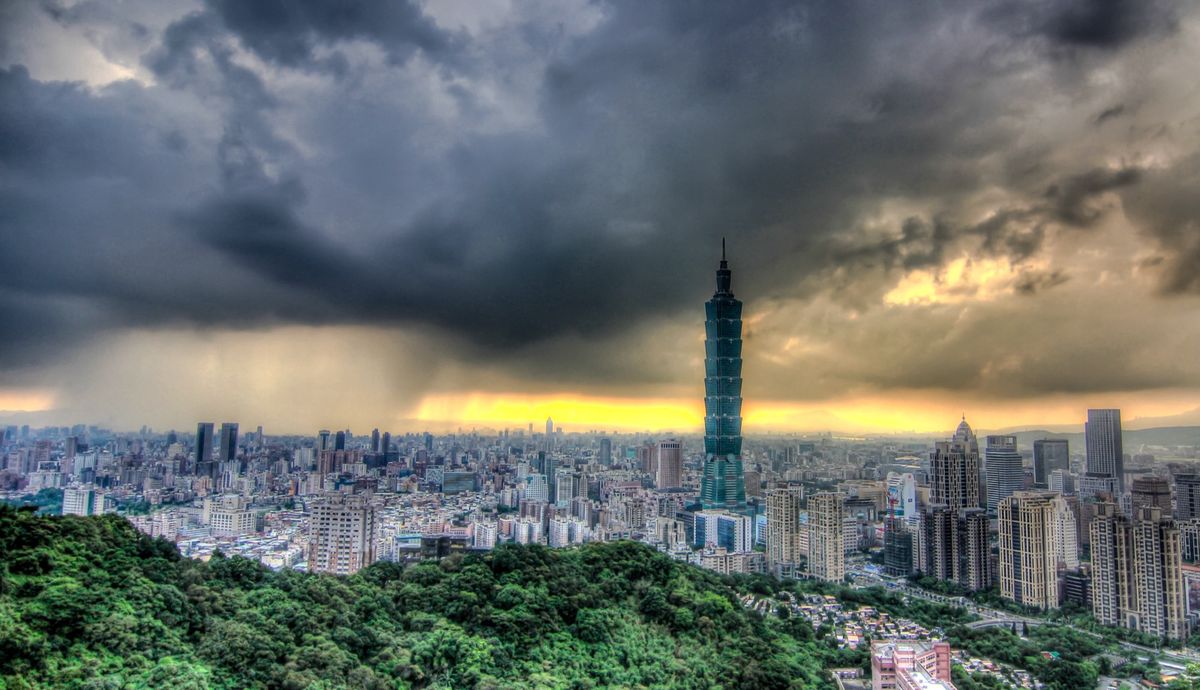
Photo: ynes95 via Wikimedia Commons, CC BY-SA 2.0
How a typhoon day is decided
The rules are in the Regulations for Suspension of Work and Classes in Natural Disasters (天然災害停止上班及上課作業辦法). Three things matter:
- Who decides: the mayor or county magistrate of each city, not the central government. Taipei and New Taipei usually coordinate and announce together, but they do not have to, and the law tells neighbouring cities to consult before deciding.
- The trigger: a closure can be declared when the forecast says the storm will bring average winds of Beaufort level 7 or gusts of level 10 to the area within four hours, or when rainfall reaches the local threshold and is causing or likely to cause damage.
- The timing: a full-day closure should be announced between 7pm and 10pm the night before, and broadcast by 11pm. If the storm strengthens overnight, the city can still announce a closure by 4:30am the same day. A half-day closure for the afternoon or evening is announced by 10:30am.
So the 7pm to 10pm window is when the whole city refreshes the news. If nothing has been announced by 10pm, plan to go to work, and check again when you wake up.
Where to check (our pick)
Skip the rumour posts in expat Facebook groups. Two official pages are all you need:
1. The closure board: the Directorate-General of Personnel Administration posts every city's decision in one table, in English and Chinese. Bookmark the English one now.
2. The storm itself: the CWA's typhoon news page shows the sea and land warnings, the track and the forecast circle.
Your phone will also get the government's emergency alerts (災防告警) for extreme rain, landslide risk and evacuations. Do not turn them off.
Your rights if you work for a private company
Here is the part most foreigners do not know. The closure regulation only binds government offices and schools. Private employers are covered by labour law, and the Ministry of Labor's guidelines for work attendance during natural disasters say:
- If the city where you work, where you live, or that you must pass through on your commute has announced a closure, you may stay home.
- Your employer cannot treat that as an absence, force you to use personal or annual leave, make you make up the hours, deduct your attendance bonus, fire you or otherwise penalise you.
- The guidelines say employers should not deduct your pay for that day. That is a recommendation, not a requirement, so whether you are paid depends on your contract and your company. Ask HR before typhoon season.
- If you are asked to come in and do, you should be paid for the day, and the ministry encourages extra pay and help with transport.
Employers who break the related Labor Standards Act rules can be fined NT$20,000 to NT$1,000,000. Many offices in Taipei close when the city does, but that is the employer's call, so check your company's policy. Shops, restaurants, hospitals and convenience stores often stay open, so if you work in one of those, ask your manager what the plan is before the storm, not during it.
Taiwan typhoon preparation: our two-day list
You do not need a doomsday bunker. You need two quiet days at home with no power for a few hours. What we stock:
- Drinking water: 3 litres per person per day, for 2 to 3 days. That is the same 3 litres a day that Taipei Water's emergency supply stations are designed to give each resident in a disaster. Taipei Water also warns that heavy rain makes river water muddy and power cuts can stop the pumps, and asks residents to store water before a storm.
- A full bathtub or a few buckets of tap water for flushing the toilet if the water stops.
- Food that needs no cooking: bread, crackers, peanut butter, canned tuna, fruit, instant noodles if your kettle runs off gas or you still have power. Supermarket vegetable shelves are often bare the evening before a big storm, and vegetable prices jump for a week or two after, so buy fresh the day before.
- A full power bank, a torch, and phones charged.
- Some cash. Card machines and ATMs go down with the power.
- Any medicine you need for the next few days.
Then prepare the apartment:
1. Bring everything in from the balcony: plants, laundry racks, shoes, the drying rack you forgot about. These become flying objects at level 10 gusts.
2. Close and latch every window. Taiwanese windows are often sliding aluminium frames; if water gets in along the track, roll up a towel along the sill.
3. Clear the balcony floor drain so rain does not pool against the door.
4. Know where the water meter, main valve and breaker box are, in case of a leak or a short.
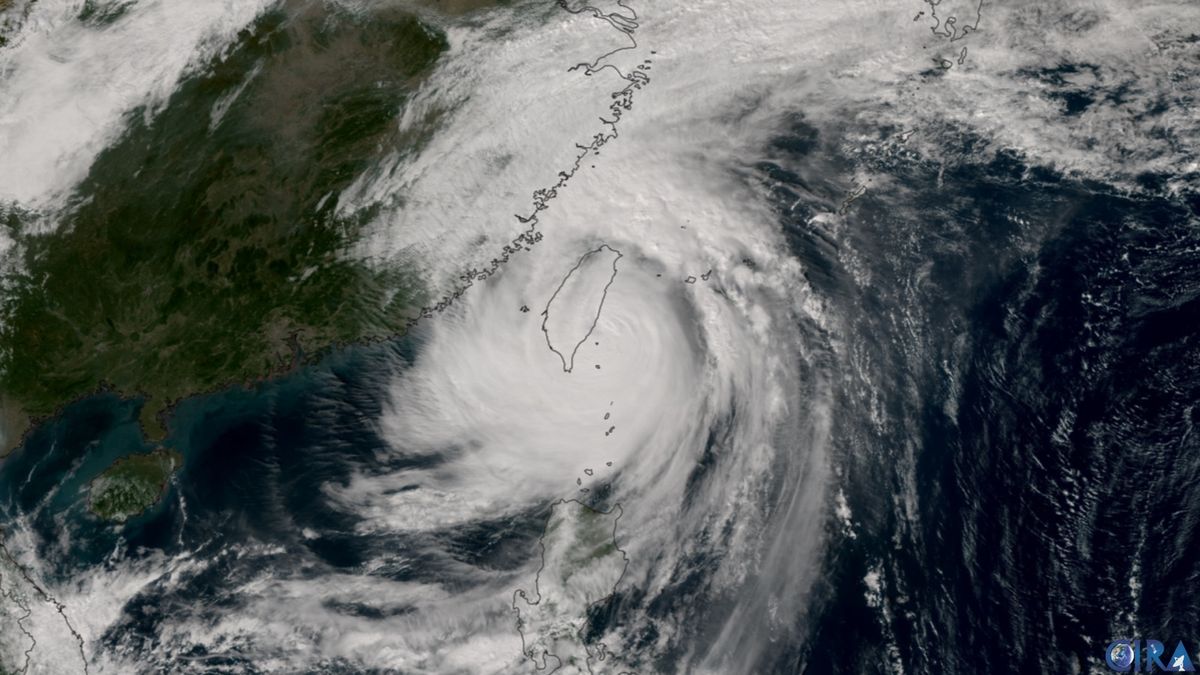
Typhoon Kong-rey making landfall in Taiwan, October 2024. Image: GEO-KOMPSAT imagery, CSU/CIRA and KMA, NOAA/NESDIS via Wikimedia Commons, public domain
What to do on a typhoon day in Taiwan
- Stay in at the peak. The danger in a city is not the wind knocking you over; it is signboards, scaffolding, branches and roof sheets flying off buildings. Locals do go out in the calm hours, but not when the warnings say the storm is closest.
- Stay away from windows when the wind is strong.
- Do not ride a scooter. Gusts and flooded underpasses are how most typhoon injuries on the road happen.
- Think twice about ordering delivery. The platforms often keep running with a bad weather surcharge, but the rider is the one on a scooter in a typhoon. If you prepped, you don't need to.
- Expect transport changes. The MRT usually keeps running unless a section floods or is too windy above ground, while buses, high speed rail, ferries and domestic flights can be cut back or cancelled.
- Do not go to the river, the coast or the mountains, during or for a day or two after. Rivers rise fast and hillsides slide when they are soaked.
If something does go wrong, 119 is fire and ambulance, 110 is police. Our guide to emergency numbers in Taiwan explains what to say and how to get an interpreter.
If you're flying in or out
Typhoons and travel plans collide every summer. Domestic flights and ferries to the outlying islands are usually the first to stop; international flights at Taoyuan get delayed, cancelled or moved forward to beat the storm. If you are booked in the next few days, check your airline's app the evening before and again in the morning rather than heading to the airport on hope. Many airlines waive change fees for typhoon disruptions, but rebooking fills up fast, so act early. If you are arriving, have a plan B for your first night in case you land many hours late or a day later than expected.
After the storm
- Check for water along window frames, ceilings, under the balcony door and inside closets on exterior walls.
- Photograph any damage and message your landlord the same day, in writing. Leaks from the roof, windows or walls are normally the landlord's repair.
- Dry everything fast. Wet walls and carpets in Taipei humidity grow mold within days. Run the dehumidifier and AC dry mode; our mold and humidity guide has the full setup.
- Run the tap for a minute before drinking. Muddy source water after heavy rain means the water plants add more chlorine; Taiwan's drinking water standard allows free chlorine up to 3.0 mg/L, instead of the usual 1.0, when source water turbidity goes above 1,500 NTU. It is safe, but it tastes like a swimming pool. Our guide on whether you can drink Taiwan tap water explains what a filter does about that.
- Watch for fallen trees and wires on your first walk out, and expect the streets to be messy for a day.
Your apartment matters more than the storm
Whether a typhoon is a cosy day off or a mopping marathon depends mostly on where you live. Top floor units, especially illegal rooftop additions (頂樓加蓋) with metal roofs, leak and get hot and loud. Basement and ground floor units in low-lying streets can flood. Old aluminium windows with tired seals let water in sideways.
If you are still choosing a place, read what to check for humidity, mold and typhoons in a Taipei apartment and our guide to rooftop additions and subdivided units.
When a typhoon has already left a mess
Two ways we can help after a storm:
- Cleaning up. If water got in, the next week is about stopping the mold. Our cleaning service does a deep clean of wet closets, window tracks, bathroom grout and the corners where damp collects. We quote individually; message us on LINE. Structural leaks are still your landlord's job, so report them in writing.
- Moving somewhere that doesn't leak. If your first typhoon taught you that your apartment floods or drips every storm, TRA's home search views places with you in person, so you can check ceiling stains, window seals and water marks along walls and floors together, and we can ask the landlord in Chinese what happened in the last big storm.
FAQ
What time are typhoon days announced in Taipei?
Full-day closures are announced between 7pm and 10pm the night before. If the storm strengthens overnight, the city can still announce by 4:30am. Afternoon closures are announced by 10:30am.
Do I get paid on a typhoon day in Taiwan?
It depends on your employer. The Ministry of Labor says employers should not deduct pay and cannot treat the day as an absence, cut your attendance bonus or punish you, but full pay is a recommendation, not a legal requirement. Check your contract or ask HR.
Is the Taipei MRT open on typhoon days?
Usually yes, at least partly. It can suspend above-ground sections in very strong winds or close flooded stations, so check announcements before you go out.
How many typhoons hit Taiwan each year?
About three to four in an average year, according to the Central Weather Administration, mostly from July to October.
Is it safe to stay in Taipei during a typhoon?
Yes, if you stay indoors at the peak, away from windows, rivers and hillsides. Most injuries come from flying objects, falls and people going out on scooters or to watch the waves.