Mold and Humidity in Your Taipei Apartment: The Setup That Actually Works
By Raytio RayUpdated
How to prevent mold in Taiwan apartment life: real humidity numbers, which dehumidifier to buy and what it costs to run, AC cleaning, closets, and who pays.
Why your apartment gets moldy so fast
If you want to prevent mold in Taiwan apartment life, you have to fight the air itself. According to the Central Weather Administration's 1991 to 2020 averages, Taipei's relative humidity never drops below about 70% in any month: it peaks at 78% in February, sits around 75 to 77% from November to June, and only dips to about 71% in July. Taipei also gets rain on roughly 163 days a year. Mold grows happily above about 70%, so left alone, almost every Taipei apartment will grow it.
Foreigners on Forumosa describe the same shock: walls that "sweat", a door magnet that rusted within two months, a pillow that went moldy against the window wall. The fix is boring but works: a decent dehumidifier, a few cheap habits, and knowing what is your problem and what is your landlord's.
If you are still choosing a place, read our viewing guide on how to check an apartment for leaks, mold and typhoon risk before you rent. This guide is for people already living here.

Photo: Wikimedia Commons, public domain
Your target: 50 to 60% indoors
Buy a hygrometer first: a Xiaomi Mijia Bluetooth one costs about NT$190 on PChome. Put it in your bedroom, away from the window. Aim for 50 to 60%. Below 60%, mold struggles; going much below 50% just wastes electricity.
The best dehumidifier in Taiwan for your space
A dehumidifier (除濕機) is the single most useful thing you will buy here. Ignore the tiny NT$1,000 "dehumidifiers" on Shopee: those are Peltier units that remove a cupful a day and make no real difference. A Forumosa user put it bluntly: under about NT$3,000 to 4,000 you will not get a compressor, and without a compressor you will not beat Taipei air.
Read the label
- 每日除濕能力 (daily dehumidifying capacity): liters per day. The local rule of thumb is about 1 liter per ping (1 ping is about 3.3 square meters). A 6 ping studio needs 6L; a 10 to 12 ping bedroom or one-bedroom apartment needs 10 to 12L; a whole two-bedroom with laundry drying inside needs 16L or more. If you dry clothes indoors, add 2 to 4L.
- 能源效率分級 (energy efficiency grade): the Energy Administration label runs from grade 1 (most efficient) to 5. Buy grade 1. Taiwan tightened the grade 1 standard in 2026, so newer models are marked as meeting the new grade 1.
- 連續排水 (continuous drain): lets you attach a hose and drain into a floor drain or bathroom, so the tank never fills and stops the machine. Worth having if you will run it nonstop in rainy season.
What it costs (PChome prices, October 2026, approximate)
- Budget: Sampo 6L grade 1 (AD-WB512T) around NT$5,200, Sampo 10.5L around NT$8,000, Whirlpool 6L around NT$4,500 to 6,000.
- Mid-range: Hitachi 7L grade 1 (RD-14FJ) around NT$8,000, Hitachi 9L around NT$9,000 to 10,000, Panasonic 11L (F-Y22PN) around NT$9,900.
- Inverter (quieter, cheaper to run): Panasonic 12L (F-YV24NN) around NT$14,500, Panasonic 16L (F-YV32NN) around NT$15,800, LG PuriCare 12L dual inverter around NT$13,900.
- Premium: Mitsubishi 15.2L inverter around NT$18,800, Mitsubishi 22.5L around NT$27,800.
Costco and momo carry the same brands at similar prices, with discounts before the plum rain season (梅雨) in May and June.
Compressor or desiccant? Almost everything sold here is compressor, and that is right. Desiccant (zeolite) units only win in real cold, which Taipei rarely gets, and they use more electricity.
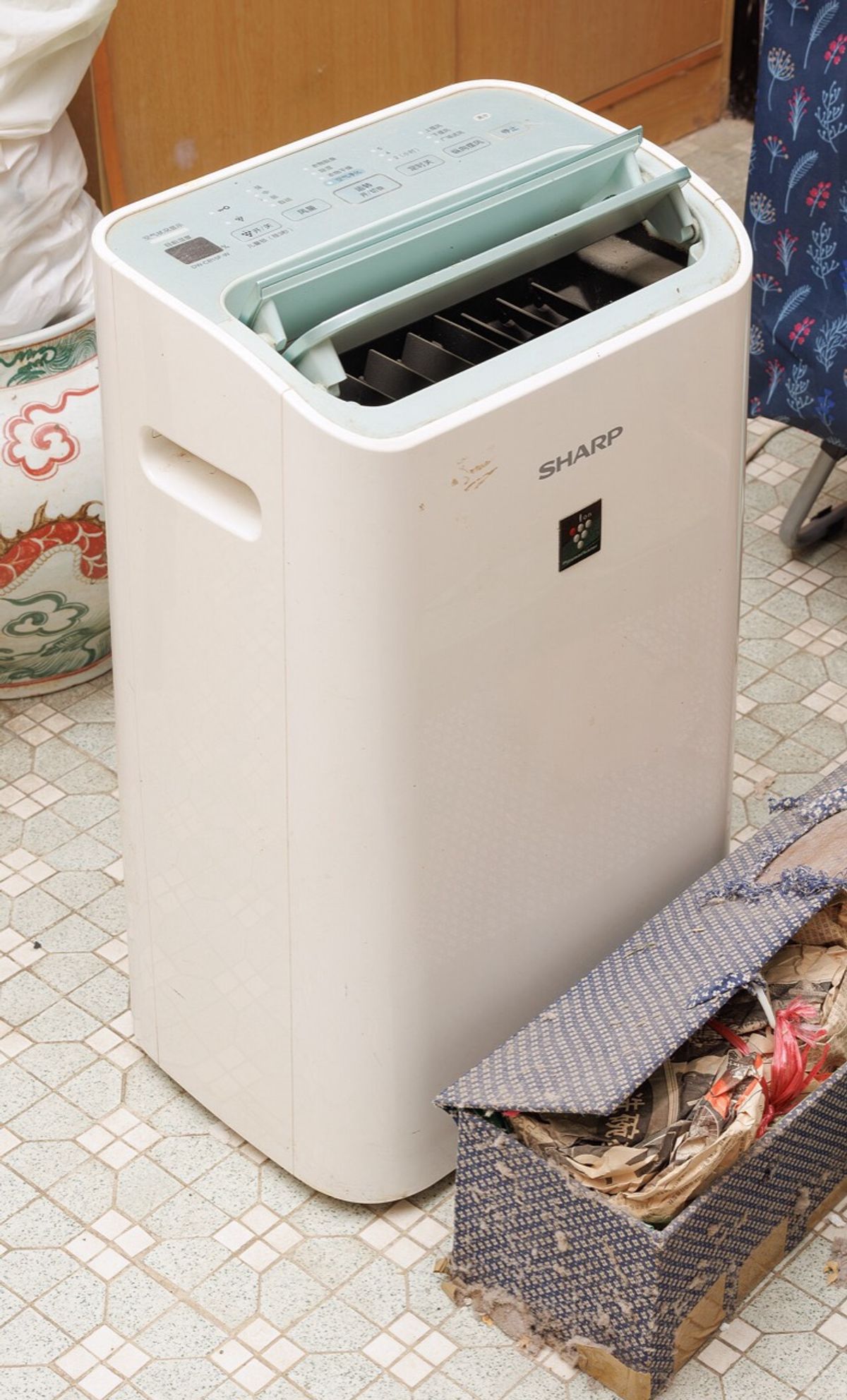
Photo: Dinkun Chen via Wikimedia Commons, CC BY-SA 4.0
Where to put it and when to run it
- Close the room. With a window open, you are dehumidifying Taipei.
- Keep it 20 to 30 cm from walls and furniture so air can get in and out, ideally near the middle of the room or facing the open closet.
- Set it to 55% on auto. It cycles off when the room is dry, so it runs most of the day in spring and barely at all in a dry October week.
Electricity cost: a 12L grade 1 unit draws roughly 4 to 5 kWh a day if it runs flat out. On auto at 55%, most one-bedroom apartments use around 1.5 to 3 kWh a day. At Taipower's average residential rate of roughly NT$3.8 per kWh in 2026, that is about NT$150 to 350 a month, and up to about NT$500 in a soaking wet month. Our guide to utility bills in Taiwan explains how the tiered rates work.
Your air conditioner: dry mode and mold
Most rentals have split AC units, and their dry mode (除濕, usually a water drop icon) removes a lot of moisture. One Forumosa resident keeps their room under 60% with the AC alone. In summer, AC plus a bedroom dehumidifier is plenty.
The catch is that the AC itself grows mold. If you see black specks on the louvers or the blower wheel inside the vent, or the air smells musty when it starts, it needs cleaning.
- You: wash the mesh filters every 2 to 4 weeks in summer. They pop out by hand.
- A pro: the blower wheel and coils need a proper wash with pressurized water and a drip bag. In Taipei, a standard wash of a split indoor unit costs roughly NT$1,800 to 2,500, and a full disassembly clean NT$2,500 to 4,500 (PRO360 price guides). Do it once a year, ideally in April before the summer rush.
On Forumosa, one tenant's landlord "cleaned" the AC by wiping the filter, then quoted NT$3,000 plus for a real clean at the tenant's expense. Landlords differ: some pay, some split 50/50, some refuse. Ask in writing.
Closets, bathrooms, shoes and beds
Closets: keep doors open a crack, leave a hand's width between clothes and the wall, and drop in disposable moisture absorbers (除濕盒). Refill packs from brands like 妙管家 or 克潮靈 cost around NT$50 to 60 for three at PX Mart, Carrefour or PChome. When the bag is full of water, change it.
Bathroom: run the exhaust fan for at least an hour after showering (or leave it on), squeegee the walls and floor, and leave the door open afterward. Wash bath mats weekly.
Shoes and leather: dry wet shoes before they go in the cabinet, keep a 除濕盒 in there, and wipe leather bags and belts every few weeks in spring.
Futons and mattresses: a mattress on the floor or a solid platform molds underneath. Use a slatted base or breathable mat, stand it up every few weeks, and keep the bed off the exterior wall.
Surface mold vs 壁癌
These are two different problems and they have different owners.
- Surface mold: black, green or grey spots on paint, grout, silicone or window frames, where air is still: corners, behind wardrobes, the exterior wall. It scrubs off. Usually a ventilation problem, which is on you.
- 壁癌 ("wall cancer"): white powdery crystals, bubbling or flaking paint, crumbling plaster, often low on walls or around windows and ceilings. It is water moving through the concrete from leaks or rising damp. You cannot fix it by cleaning, and repainting over it only hides it for a season.
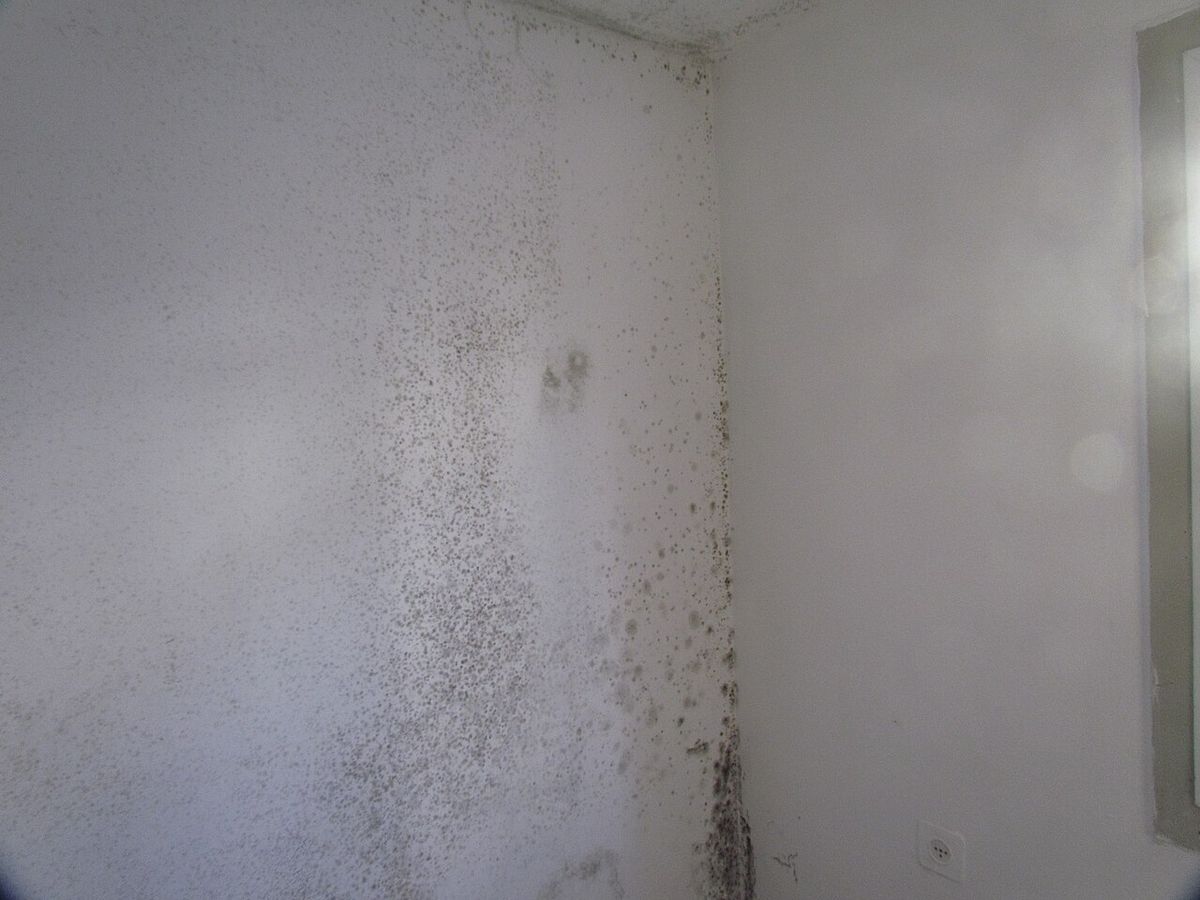
Photo: שי אבידן via Wikimedia Commons, CC BY-SA 4.0
Cleaning mold safely
For grout, tiles and silicone, use household bleach (漂白水) diluted roughly 1 part to 10 to 15 parts water, or a ready-made mold gel (除霉膠) from Watsons or PX Mart for silicone lines. Wear gloves, open the window, run the fan, and rinse with clean water afterward.
Never mix bleach with acidic cleaners, including toilet cleaners containing hydrochloric acid (鹽酸) or vinegar: the mix releases chlorine gas. On painted walls, wipe gently, dry the area, then fix the humidity, or the spores come back.
Who pays: landlord or tenant
The Ministry of the Interior's mandatory terms for residential leases (住宅租賃定型化契約應記載事項) say the landlord is responsible for repairing the home and its fixtures, unless the contract says otherwise or the damage is the tenant's fault. In practice:
- Landlord: roof and window leaks, plumbing leaks inside walls, 壁癌 caused by water in the structure, broken exhaust fans, and broken AC units.
- Tenant: ordinary surface mold from drying laundry inside with windows shut, never running a fan, or blocking airflow behind furniture.
If the landlord's repair is needed, message them with photos and a reasonable deadline. Under the same rules, if they do not repair it in time, you may repair it yourself and ask for reimbursement or deduct the cost from rent. Keep everything in writing.
For your deposit (capped at two months' rent), the defense is evidence. Photograph every wall, corner, closet and AC vent at move-in and attach them to the property condition record (租賃標的現況確認書). Our guide to a normal Taipei rental contract explains the clauses to look for.
Our exact setup to prevent mold in Taiwan apartment living
For a typical 8 to 12 ping studio or one-bedroom, this is what we recommend:
- One 12L grade 1 inverter dehumidifier in the bedroom (Panasonic F-YV24NN or LG 12L if you can spend around NT$14,000; Sampo 10.5L at around NT$8,000 if you cannot), set to 55% on auto, with a drain hose in rainy season.
- A NT$190 hygrometer so you know the number instead of guessing.
- 除濕盒 in every closet and the shoe cabinet, changed when full.
- Bathroom fan on after every shower.
- AC dry mode in summer, filters washed monthly, a professional clean every April.
Do this from your first month and you will not be the one on Forumosa asking why your pillow is green. For storm season, see what typhoon days in Taiwan actually look like.
When the mold is already there, or you're ready to move
Two ways we can help, depending on where you are:
- Mold in your current flat. Our cleaning service can do a deep clean of the mold-prone spots in this guide: bathroom grout and silicone, window frames, closets and the corners behind furniture. It handles surface mold; 壁癌 is a building problem for your landlord. If you're moving out, a move-out clean also helps with the deposit conversation. We quote individually; message us on LINE.
- Moving to a drier place. When we help you find your next apartment through TRA's home search, we view places with you in person, so you can check for 壁癌, water stains on ceilings and around windows, musty closets and bathrooms without a working fan together, and we can ask the landlord in Chinese about leaks after typhoons.