Xingtian Temple: A Newcomer's Guide to Taipei's No-Incense Temple
By Raytio Ray
Xingtian Temple Taipei guide: how to get there, hours, the free shou jing blessing, moon blocks and fortune sticks step by step, etiquette and fortune tellers.
Xingtian Temple Taipei (行天宮, also spelled Hsing Tian Kong) is the temple we send every newcomer to first. It's busy, local and genuinely used every day, yet it's also the easiest temple in the city for a foreigner to take part in: there's no incense to buy, no donation box, no paid ritual, and volunteers will perform a free blessing on you if you join the line. Here's how it works and what we think you should actually do there.
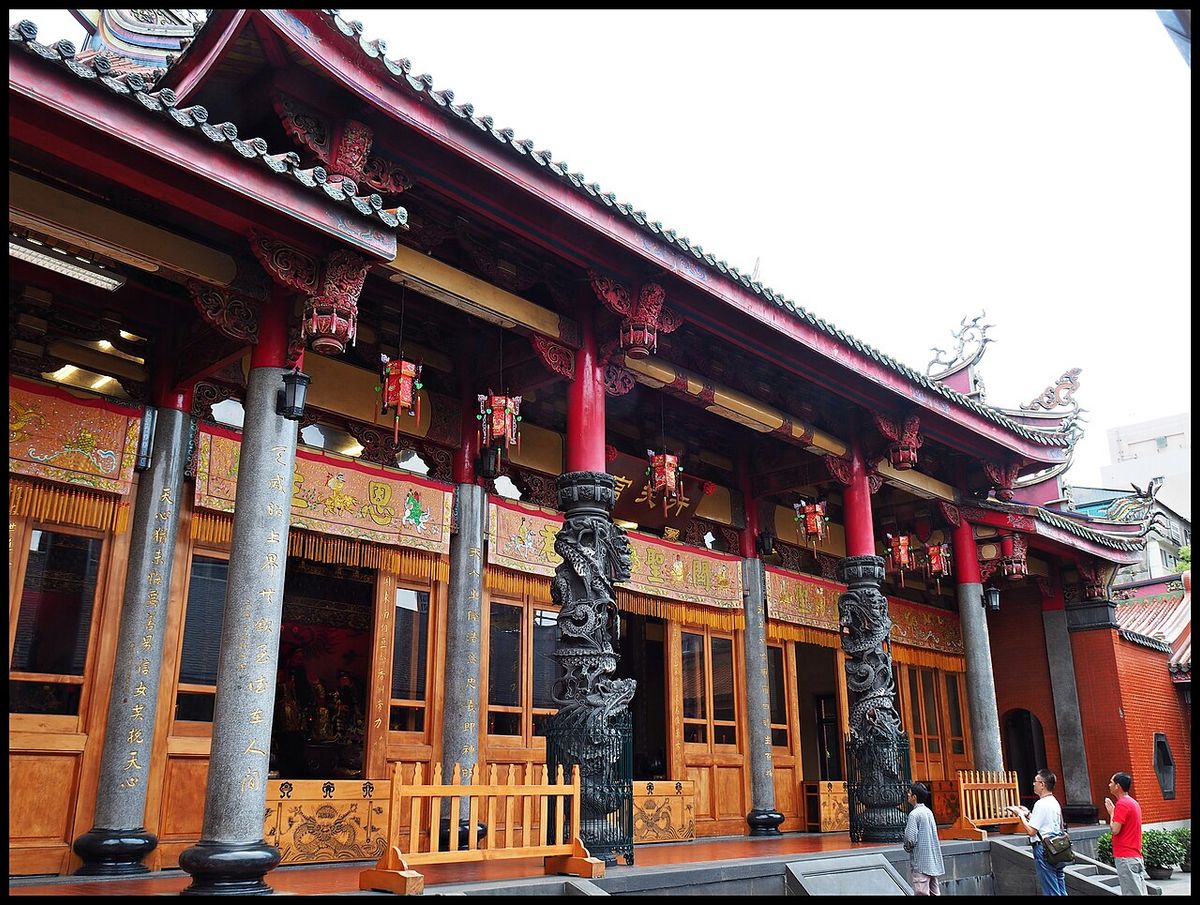
Photo: Peter C in Toronto Canada via Wikimedia Commons, CC BY 2.0
Getting to Xingtian Temple Taipei and opening hours
Address: No. 109, Section 2, Minquan East Road, Zhongshan District, on the corner of Songjiang Road. Phone (02) 2502-7924.
MRT: Xingtian Temple Station (O09) on the Orange line, Xinlu branch. Take Exit 3 and walk north up Songjiang Road for about 6 to 8 minutes. From the Red line, change to the Orange line at Minquan West Road; from the Blue line, change at Zhongxiao Xinsheng. Make sure you board a train toward Luzhou, not Huilong.
Hours: the temple is open daily from 4:00am to 10:00pm. Entry is free. Each service has its own window, and these matter more than the gate hours:
- Shou jing (blessing ritual): around 11:20am to 6:30pm, paused about 2:30 to 3:00pm for the daily sermon
- Moon blocks: 4:00am to 9:00pm
- Fortune sticks: 7:30am to 8:30pm, but not at all on the 1st and 15th of each lunar month at this temple
Check the official site, ht.org.tw, for suspension days.
Who is worshipped here
The main deity is Guan Gong (關聖帝君, Guan Yu), the Three Kingdoms general who became the god of loyalty and righteousness. In Taiwan he's the patron of businesspeople, police and the military, so expect office workers praying about deals and job interviews at lunch.
He shares the main hall with four other "En Zhu" (恩主, benefactor) deities, together called the Five Saviors: Lu Dongbin, Zhang Dan, Wang Shan and the Song dynasty general Yue Fei. Guan Yu's son Guan Ping and his attendant Zhou Cang stand beside him. Locals often call the whole temple "En Zhu Gong".
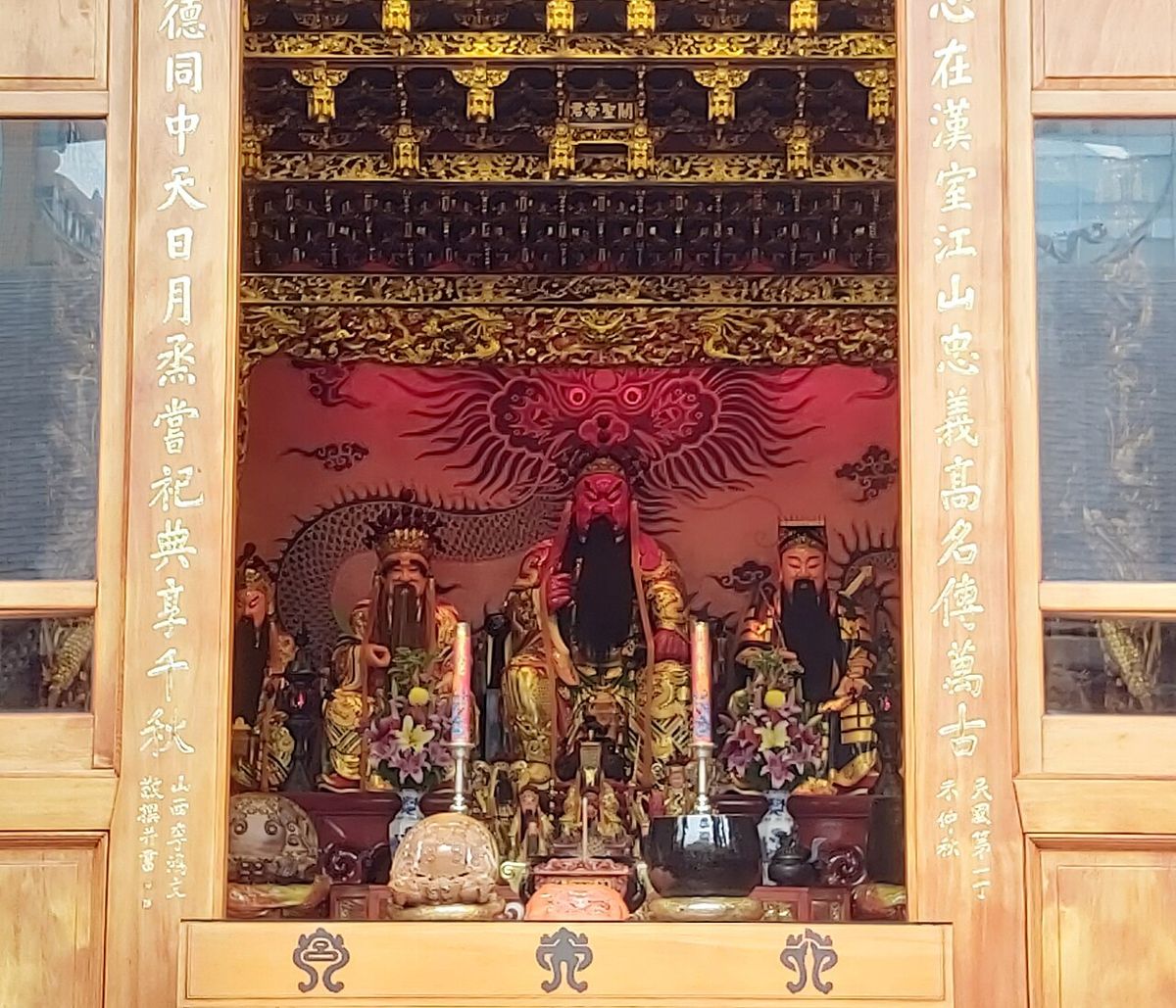
Photo: 阿道 via Wikimedia Commons, CC BY-SA 4.0
A short history
The temple was founded by Huang Tsung (黃欉, 1911 to 1970), a coal mine owner from Shulin known by his religious name Master Hsuan Kung (玄空師父). After building temples in Beitou and Sanxia, he bought land on Minquan East Road in 1964; the Taipei main temple was completed in 1967 and consecrated in January 1968.
What makes it different from other temples
Most Taiwanese temples run on donations, paid rituals and huge amounts of burnt incense and paper money. Xingtian Temple deliberately rejects all of that. Its official rules, unchanged since the founding: no spirit mediums, no burning joss paper, no gold medals to thank the gods, no opera performances, no animal sacrifices, no donation boxes and no profit-making.
In August 2014 it went further and removed its large incense burners and offering tables. Instead of lighting incense, you simply put your palms together and pray. The founder's line, which the temple still quotes, is that faith doesn't need to be expensive: a good heart gives off its own fragrance.
For a newcomer that means nobody sells you anything and you can take part fully without spending a dollar.
You'll also notice volunteers in sky blue robes everywhere. They're called xiaolaosheng (効勞生), unpaid devotees who run the rituals, guide visitors and keep the halls clean. Many are grandmothers who have been doing it for decades.
Try this first: the free shou jing blessing
Our top recommendation is shou jing (收驚), often translated as "soul calming" or "fright removal". It's for when you've had a shock, can't sleep or feel scattered, which describes plenty of people in their first weeks in a new country.
How it works:
- Head to the worship pavilion in front of the main hall during shou jing hours. You'll see short lines of people facing blue-robed volunteers holding lit incense sticks.
- Join any line. When it's your turn, the volunteer asks your name. Say it clearly; English names are fine.
- Stand still with your hands relaxed or palms together. The volunteer waves the incense around and over you while reciting a prayer. It takes under a minute.
- When they finish they'll say "ping an" (平安, peace). Say "ping an" back. That's the temple's standard greeting and thank you.
It's free. Don't try to tip. If you still feel unsettled, the temple says you can come back the next day and do it again. Shou jing is suspended during Lunar New Year (New Year's Eve to the 5th day), the spring and autumn prayer ceremonies (lunar months 3 and 9, days 1 to 10), Guan Gong's birthday (lunar 6/24) and major holidays like Tomb Sweeping, Dragon Boat, Ghost Festival and Mid-Autumn.
Moon blocks and fortune sticks, step by step
Moon blocks (擲筊, bwa bwei)
The two red crescent-shaped blocks are how you ask the gods a yes or no question.
1. Hold the pair in your palms and silently tell Guan Gong your name, age, address (the area you live in is fine) and one clear question.
2. Pause, then hold them at forehead height and drop them to the floor.
3. Read the result. One flat side up and one round side up is a "holy block" (yes). Two round sides up means no. Two flat sides up is a "laughing block": the question wasn't clear, so rephrase and try again.
One rule specific to this temple: you ask once and accept the answer. Throwing again and again until you get a yes is considered disrespectful here, and the temple asks you to wait some time before asking the same question again.
Fortune sticks (求籤)
1. Introduce yourself to Guan Gong as above and state one matter you want guidance on.
2. Throw the moon blocks. You need a holy block before you can draw.
3. Draw one stick from the container, note its number and code (for example "No. 8, 甲辛"), then put the stick back.
4. Throw the moon blocks again to confirm that's your stick. No holy block means draw another stick and repeat.
5. Take the number to the temple office counter that hands out poems (發籤詩處). They give you the printed poem and staff will explain it.
The poems are written in classical Chinese, and interpretation is in Mandarin or Taiwanese. Unless your Chinese is strong, bring a Taiwanese friend for this one. The explanation is usually practical advice, and it's a great conversation starter.
Etiquette in two minutes
- Dress neatly. The temple asks for clean, tidy clothing; nothing formal.
- Keep your voice down, don't stand in front of people who are kneeling or praying, and don't point at the deity statues.
- Common Taiwanese temple custom is to enter through the right-hand door as you face the temple and leave by the left. Locals won't scold you for getting it wrong, but it's a nice touch.
- Photos of the buildings are fine. Don't photograph people during shou jing or while they're praying, and skip the flash inside the halls.
- Kneeling is optional. The temple's full bow is three kneels with three head touches each, but standing with palms together is completely acceptable, and the temple says so itself.
The fortune-teller street underneath
Cross the road through the Songjiang to Minquan pedestrian underpass and you'll find "The Street of Fortune Telling" (命理大街): roughly 20 small booths that have been here for over 30 years, offering palm and face reading, Chinese astrology (bazi, Zi Wei Dou Shu), rice divination and bird-picked fortunes. A handful advertise English or Japanese.
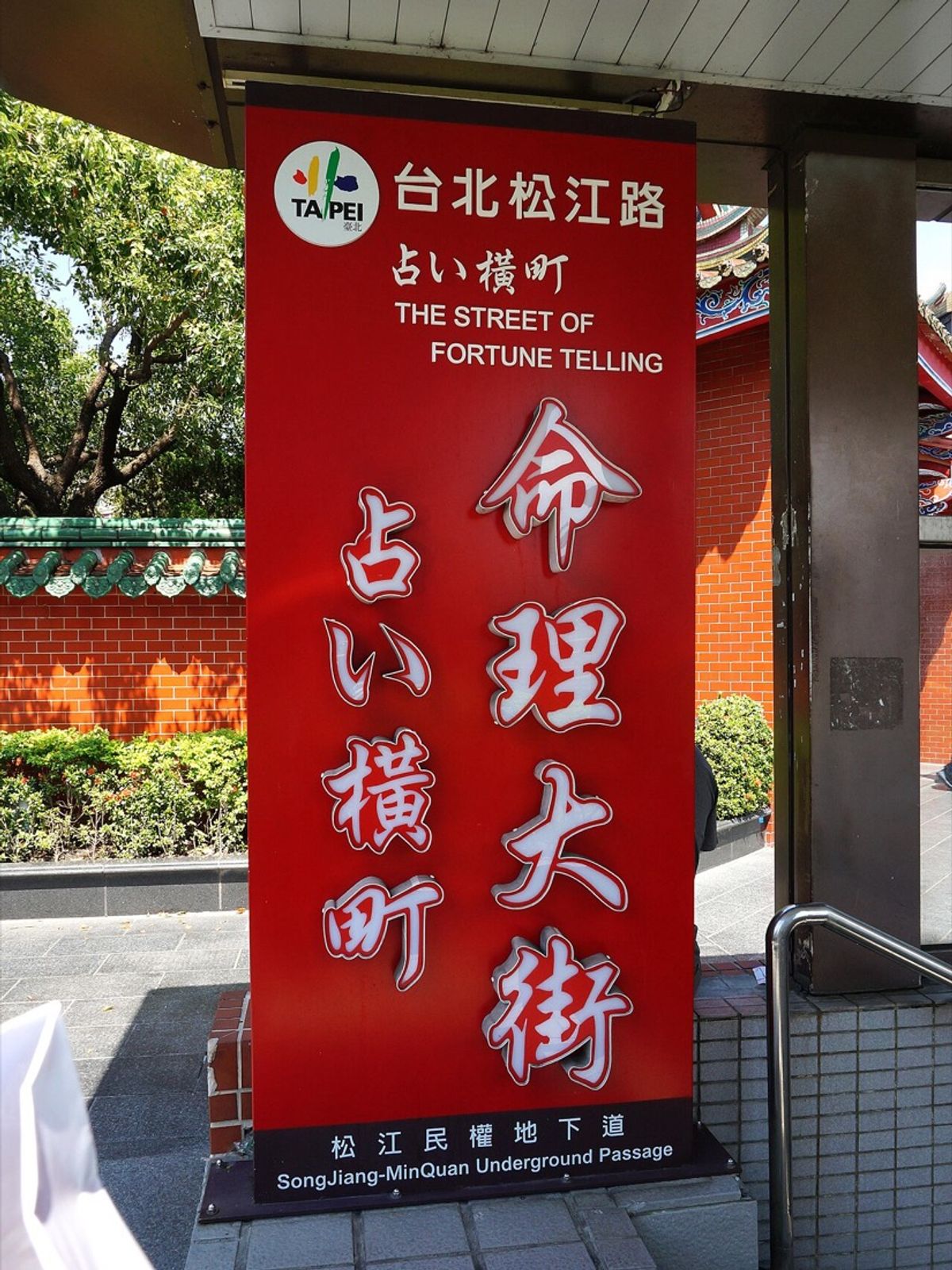
Photo: Solomon203 via Wikimedia Commons, CC BY-SA 4.0
Prices are set by each booth. A single question with rice or card divination usually runs around NT$300 to 600, and a full birth chart reading with a senior teacher can go into the thousands and take a couple of hours. Always agree on the price before they start.
Our honest take: it's entertainment and a slice of local culture, not something to make life decisions with. It's also separate from the temple, which charges nothing for its own fortune sticks. If you only have budget for one, draw a free stick upstairs.
Best time to visit
Weekday late mornings are ideal: arrive around 11:00, walk the halls, then join the shou jing line when it opens at 11:20. Early mornings are quietest if you just want to look around.
The 1st and 15th of each lunar month are the busiest days, and fortune sticks are not offered then. Go on those days if you want to see the temple at its most crowded and devotional, avoid them if you want to participate. Lunar New Year, especially the first few days, is packed shoulder to shoulder.
The temple beyond the temple
The same organization runs free libraries (the Songjiang branch is right next door at 359 Songjiang Road, others are on Dunhua North Road, in Zhongshan and Beitou), founded En Chu Kong Hospital in Sanxia in 1998, and funds scholarships and emergency relief. For many Taiwanese, a temple is a community institution, not just a place to pray.
What to combine it with
- Lunch: the side streets around the temple are full of cheap noodle and bento shops serving office workers.
- A walk: east to the tree-lined lanes of Minsheng Community, or south toward Songjiang Nanjing for cafés.
- Compare: Longshan Temple in Wanhua and Bao'an Temple in Dalongdong, both still full of incense, feel completely different.
If you're still getting used to how things work here, our pieces on Taiwanese culture before you arrive and everyday differences between Taiwan and the US cover the basics. And if you're settling into a new apartment nearby, TRA can help with move-in cleaning or a water filter installation: see our services.