Using the Post Office in Taiwan: How to Send a Parcel, Plus Mail, Bills and Savings
By Raytio Ray
Taiwan post office services step by step: sending a parcel from Taipei with 2026 rates to the US, UK and Australia, i郵箱 lockers, missed deliveries and bills.
Taiwan post office services: the short version
Chunghwa Post (中華郵政, just "郵局" in daily speech) is cheap, reliable and everywhere. For most foreigners in Taipei, Taiwan post office services come down to three jobs: sending stuff home, collecting a package you missed, and paying the odd bill. This guide walks through the first one step by step, with real 2026 prices from the post office's own rate tables, then covers the rest.
Step 1: Pick the right branch
Almost every neighborhood has a branch, and the standard weekday hours are 08:30 to 17:30. Two things to know before you walk in.
The big one: Taipei North Gate Post Office (臺北北門郵局). It's the grand old building facing the North Gate, at Zhongxiao West Road Section 1 No. 120, a short walk from Taipei Main Station or right by MRT Beimen Station. According to Chunghwa Post's own branch data it's open 08:30 to 21:00 on weekdays, which makes it our pick if you work office hours.
Saturdays. 36 branches in Taipei City open on Saturday, almost all from 09:00 to 12:00 only. North Gate, Da'an (信義路三段89號), Shilin and Neihu are on the list. Sundays: only the Palace Museum post office is open.
One trap: the small Taipei Railway Station Post Office inside the station does not accept international parcels. Walk the extra ten minutes to North Gate.
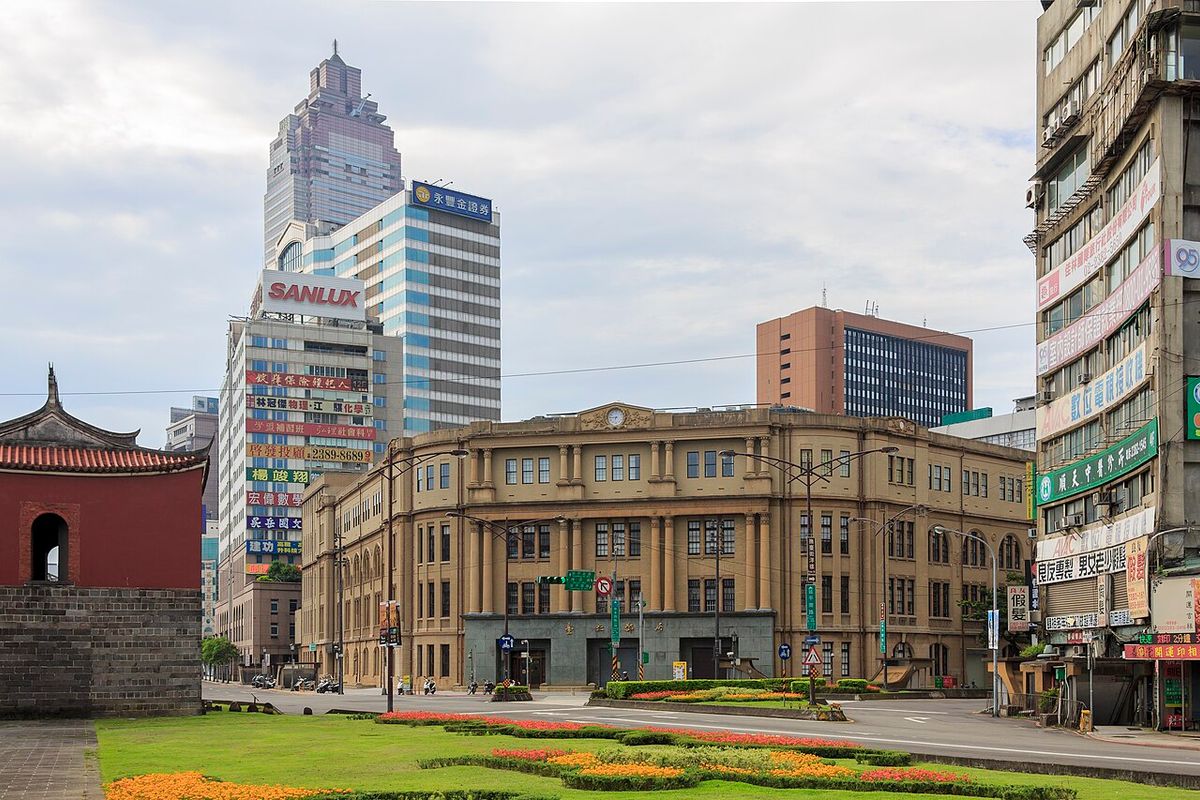
Photo: CEphoto, Uwe Aranas via Wikimedia Commons, CC BY-SA 3.0
Step 2: Take a number and buy a box
At the entrance there's a ticket machine. Most have two main buttons: 郵務 (postal: letters, parcels, stamps) and 儲匯 (savings and remittance: deposits, transfers, bill slips). For a parcel, press 郵務. Bigger branches sometimes add separate buttons for parcels or stamp collecting; if you're unsure, show the guard at the door your box and they'll press it for you.
The post office sells corrugated boxes at the counter. Official prices:
- Box: Flat | Outer size (cm): 23 x 16 x 7 | Price: NT$15
- Box: Small | Outer size (cm): 23 x 16 x 18 | Price: NT$20
- Box: Medium | Outer size (cm): 29 x 21 x 32 | Price: NT$30
- Box: Large | Outer size (cm): 39 x 32 x 43 | Price: NT$45
Tape and a packing table are usually there too. Pack at home if you can: the tables fill up at lunchtime.
Step 3: Sending within Taiwan
Domestic parcels are priced by weight and distance, up to 20 kg. Taipei, New Taipei and Keelung count as one area. Current counter rates:
- Up to 5 kg: NT$70 within the same area, NT$80 to another county on the main island.
- 5 to 10 kg: NT$90 same area, NT$100 elsewhere.
- Delivered to an i郵箱 locker instead of a door: NT$22 cheaper (for example NT$48 instead of NT$70).
Fill in the domestic parcel slip (sender and recipient in Chinese or English, plus phone numbers) and hand it over. Delivery is usually within a couple of working days. For a small item to a friend, a convenience store store-to-store service can be just as cheap; see our convenience store guide.
i郵箱: the 24-hour parcel locker
i郵箱 (i-Box) are Chunghwa Post's self-service lockers, over 2,000 of them, outside post offices, in MRT stations (Beimen, Gongguan, Ximen and many more) and in apartment lobbies.
To send from one: create the shipping label first on EZPost (ezpost.post.gov.tw), go to the locker, scan the QR code, let it print the label, pick a compartment size and pay. Lockers do not take cash or credit cards: pay with EasyCard, iPASS, icash, LINE Pay or JKoPay. Max size is 45 cm on the longest side and 105 cm for length plus width plus height.
To receive at one: you get an SMS with a 6-digit code. Enter it with the last 3 digits of your phone number. You have 3 days, after which the item moves to a nearby post office for pickup.
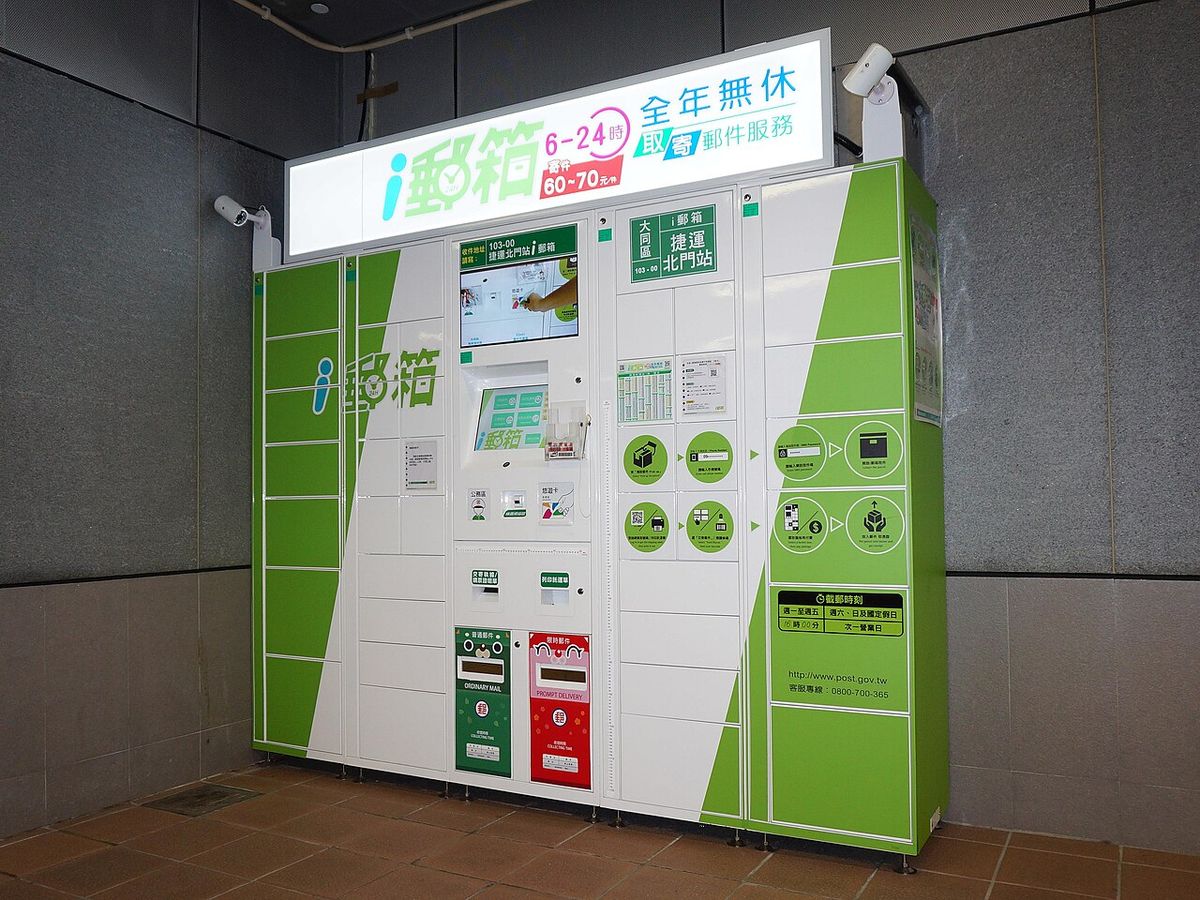
Photo: Solomon203 via Wikimedia Commons, CC BY-SA 4.0
Step 4: Sending a parcel abroad
You have four options. Prices below are for goods, from Chunghwa Post's rate tables (before any emergency surcharge). The post office charges the actual weight or the volume weight (length x width x height in cm divided by 6,000), whichever is higher, so don't use a huge box for light things.
- Option: ePacket, 1 kg (max 2 kg) | To US: NT$560 | To UK: NT$385 | To Australia: NT$405
- Option: Air parcel, 1 kg | To US: NT$605 | To UK: NT$495 | To Australia: NT$415
- Option: Air parcel, 5 kg | To US: NT$1,445 | To UK: NT$1,415 | To Australia: NT$1,255
- Option: Surface parcel, 5 kg | To US: NT$900 | To UK: Suspended | To Australia: NT$810
- Option: EMS, 1 kg | To US: NT$1,200 | To UK: NT$880 | To Australia: NT$715
- Option: EMS, 5 kg | To US: NT$2,080 | To UK: NT$1,780 | To Australia: NT$1,675
EMS (國際快捷) is the fast tracked service: the post office quotes 4 to 5 working days to the US and UK and 4 to 6 to Australia, not counting customs. Air parcel (航空包裹) usually takes one to two weeks. Surface (水陸) goes by ship and can take one to three months, and to many countries, including the UK, it is currently suspended. SAL (陸空聯運) is suspended to most destinations. ePacket (國際e小包) is a tracked small packet up to 2 kg, set up online through EZPost first.
Our pick for sending things home: under 2 kg, ePacket every time. For a 5 kg box of winter clothes or books you don't need soon, surface if your country still accepts it; otherwise air parcel. Pay for EMS only for documents, deadlines or anything valuable.
The forms. Small packets use the green CN22 customs label; parcels use the parcel dispatch note that includes the CN23 declaration; EMS has its own waybill. Write in English, list each item specifically ("2 cotton T-shirts", not "clothes") with a value, and sign. You can fill everything in on EZPost beforehand and just print it, which saves a lot of time at the counter.
What you can't send. Anything with a lithium battery (phones, power banks, laptops, e-cigarettes), aerosol cans, flammables, cash and valuables, and most liquids and fresh food. Shipping lithium battery electronics by air can mean a fine of NT$20,000 to NT$100,000 under Taiwan's aviation rules, so leave them out.
Sending to the US. After the US ended its duty-free threshold in 2025, Chunghwa Post paused US goods parcels, then resumed. From June 1, 2026, goods worth up to US$800 must have duty (10% of declared value plus a broker fee) prepaid when you post them, calculated automatically in EZPost. Documents, books and non-commercial gifts up to US$100 stay duty-free. Declare honestly.
Tracking. Your receipt has a tracking number (EMS numbers start with E). Track it on the Chunghwa Post website, then on the destination postal service's site once it lands.
When you missed a delivery
If you weren't home for a registered letter or parcel, the carrier leaves a slip (郵件招領通知單) in your mailbox. It shows the branch holding your item and the deadline. Bring the slip plus your ARC or passport (the name must match the parcel) to that branch and press 郵務. Picking up for a partner or flatmate needs their ID and a signed authorization. If you can't get there during opening hours, the post office's online redirect service (改投改寄, linked on the slip and post.gov.tw) can usually move it to an i郵箱.
Sending letters and postcards
Airmail postcards cost NT$11 to the US and Canada, NT$12 to Europe and NT$10 within Asia and Oceania. An airmail letter up to 10 g is NT$15 to the US, NT$17 to Europe. A domestic letter up to 20 g is NT$8.
Taiwan's street mailboxes come in two colors:
- Red: left slot for prompt delivery (限時, domestic express), right slot for airmail. International letters go here.
- Green: ordinary domestic mail, left slot for local (本埠) and right slot for other areas (外埠).
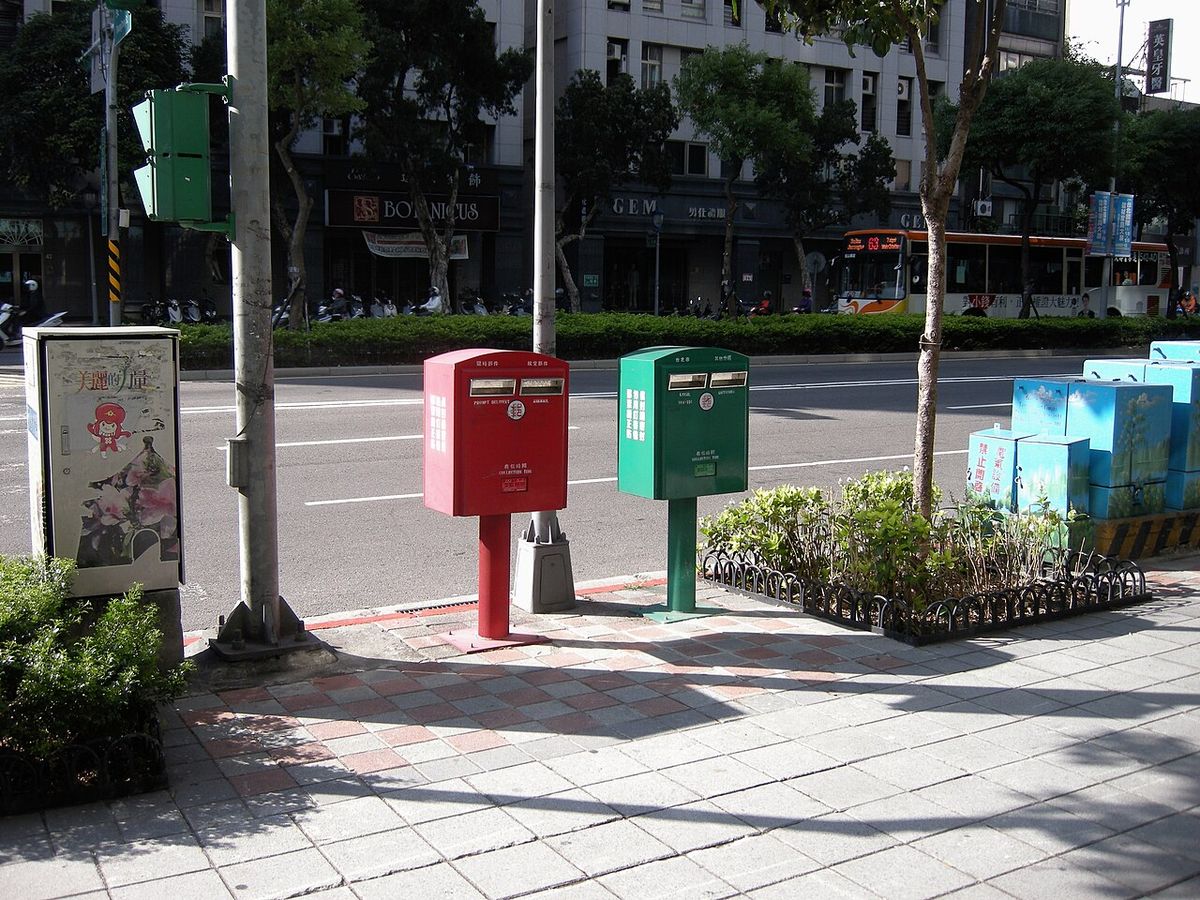
Photo: contri via Wikimedia Commons, CC BY-SA 2.0
Paying bills
Bills printed with a postal giro slip (郵政劃撥), which is common for school fees, some government fees and charities, are paid at the 儲匯 window in cash. Utility and phone bills with barcodes are usually easier at a convenience store, and once a bill is overdue the post office or the issuer is often the only place left that takes it. Our guide to utility bills explains which is which.
The post office savings account
The postal savings account (郵政存簿儲金) is many locals' everyday account, and its ATMs are in nearly every branch. As a foreign resident you'll typically need your ARC, passport, a signature or name chop, and a NT$100 opening deposit; take a 儲匯 ticket. Some branches ask for a Taiwan phone number or a second ID, so bring both if you have them. It's handy as a second account for bill payments and transfers. For how it compares with banks, read which bank to choose and our bank account and phone plan guide.
Quick checklist
- Weekday after work: North Gate, open until 21:00.
- Saturday: 09:00 to 12:00 at a list of branches only.
- Press 郵務 for mail and parcels, 儲匯 for money.
- Fill in forms on EZPost before you go.
- No batteries, no aerosols, no cash in parcels.
- Bring your ARC to pick anything up.
Moving to a new place and shipping boxes around? TRA helps newcomers find an apartment in Taipei and can help with the move-out clean when you leave. See our services.