What to Do in an Earthquake in Taiwan: A Resident's Guide
By Raytio Ray
Earthquake in Taiwan what to do: how phone alerts really work, the 0 to 7 intensity scale, Drop Cover Hold On, checking your building's age, and a kit list.
You will feel them, so get ready once
Typing "earthquake in Taiwan what to do" into your phone while the bookshelf is still rattling is a rite of passage here. Taiwan averages around 150 felt earthquakes a year according to the Central Weather Administration (CWA), out of roughly 30,000 that instruments pick up. Most are a short jolt or a slow sway. A few each year are strong enough to stop the MRT. This guide is what a local friend would tell you: what the numbers mean, what your phone will do, what to do in the first minute, and how to pick a building you can sleep in.
What a big one feels like in Taipei
On April 3, 2024 at 7:58 a.m., a magnitude 7.2 quake hit off Hualien, the strongest since 1999. In Taipei it registered intensity 5- (lower 5). People describe a long, rolling sway, water slopping out of fish tanks, and old tiles dropping off building facades. The Taipei Metro paused for safety checks and was partly running again the same day. The New Taipei Circular Line had a misaligned viaduct between Banxin and Zhongyuan stations and stayed closed much longer. Nineteen people died, almost all in Hualien, where the nine-story Uranus Building tilted over at its base.
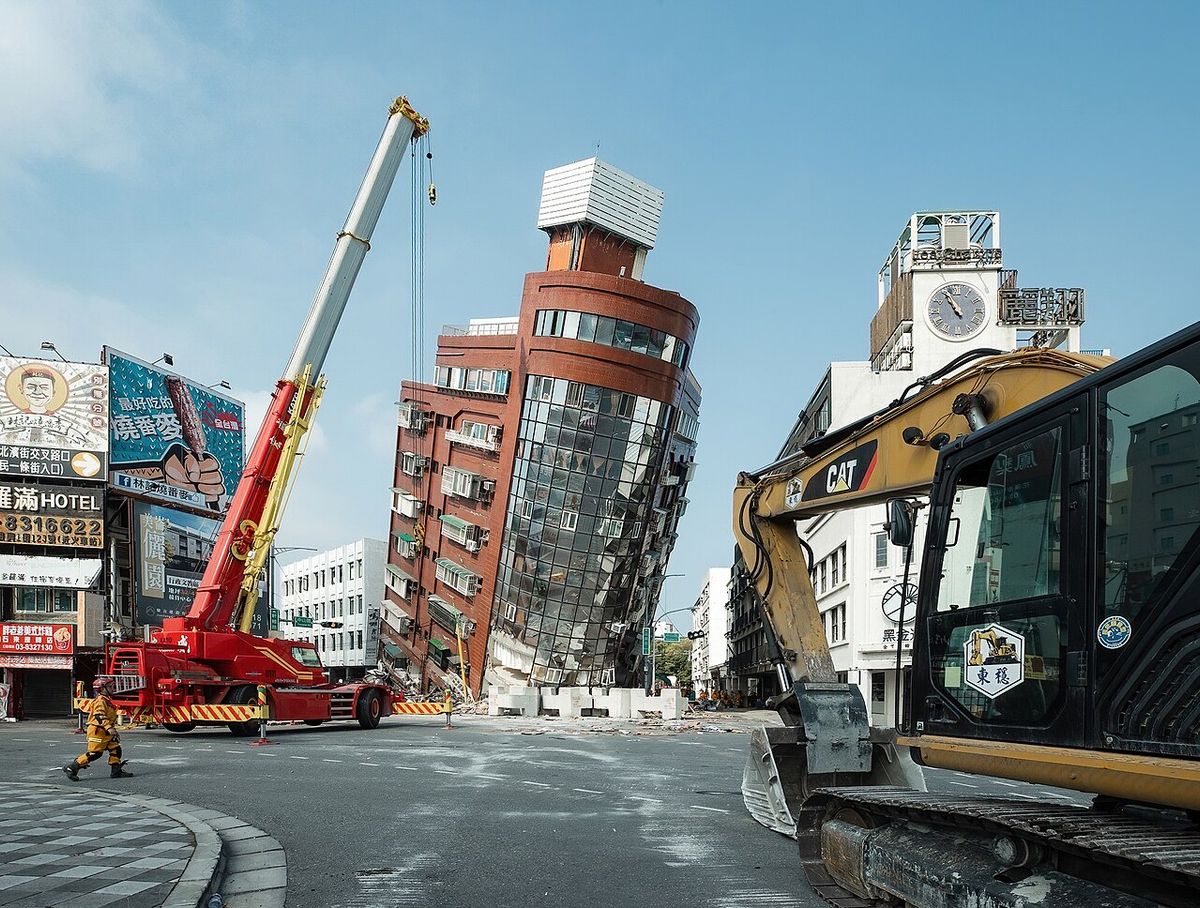
Photo: Office of the President (Shufu Liu) via Wikimedia Commons, CC BY 2.0
The Uranus Building was finished in 1986 with ground-floor shops and too few columns at the front. Remember that for the apartment section below.
The more typical "big one" looks like December 27, 2025: a magnitude 7.0 off Yilan at 11:05 p.m., intensity 4 in Taipei, every phone screaming, MRT at reduced speed for a while, then a normal night.
Magnitude vs intensity: the number that matters to you
Magnitude (規模) is the energy released at the source. One quake has one magnitude.
Intensity (震度) is how hard the ground shakes where you are, and it is what Taiwan's alerts and news reports focus on. Since January 1, 2020 the CWA uses a 10-step scale: 0, 1, 2, 3, 4, 5-, 5+, 6-, 6+ and 7. From level 5 up it is calculated from ground velocity, because that is where building damage starts.
A rough feel for it:
- 1 to 3: a jolt, hanging lights swing, you check Forumosa to see if you imagined it.
- 4: everyone notices, things rattle, some items fall. MRT slows down.
- 5- and 5+: hard to walk, furniture shifts, older facades shed tiles.
- 6 and above: serious damage to weak buildings. This is what Hualien saw in 2024.
The CWA posts every felt quake in English within minutes, with intensity by county.
How the phone alert works (and why it is inconsistent)
Taiwan's national alert (國家級警報) is sent by cell broadcast through the Public Warning System (PWS). It is the loud, repeating siren with a bilingual message. Since September 2024 the CWA sends it to a county when a quake is estimated at magnitude 5.0 or more with intensity 4 there, or magnitude 6.5 or more with intensity 3. That second rule was added because on April 3, 2024 the alert went to 12 counties but not Taipei or New Taipei, even though both shook at 5-.
What residents report on the Forumosa "Earthquakes 2026" thread matches what we hear from clients:
- The alert sometimes lands 10 seconds before the shaking, sometimes during it, sometimes after. Close to the epicenter there is no time at all.
- Two phones in the same room can disagree: one partner gets the alert, the other does not.
- Alerts for distant quakes can fire when you feel nothing. On August 25, 2026, a magnitude 5.8 off Taitung was first estimated at 6.6, and almost the whole country got a national alert. The CWA later explained it had only one nearby station to work from.
- Newer iPhones (iOS 26.2 and later) also show Apple's own "Enhanced Safety Alerts" with a far more alarming sound. Many people thought the government had changed its siren. It had not.
Our setup recommendation:
1. Use a Taiwanese SIM or eSIM. Cell broadcast reaches phones on local towers; roaming foreign phones often get it too, but a local number is the reliable option.
2. Turn on emergency alerts. iPhone: Settings, Notifications, scroll to the bottom, Emergency Alerts on. Android: search settings for "Wireless emergency alerts".
3. Don't stay on 3G only, and remember airplane mode blocks everything.
4. Install the CWA's official earthquake app, 中央氣象署E (地震測報), for fast push reports after each quake. Many residents also run the volunteer-built 台灣地震速報 (Taiwan EEW) app as a backup warning.
Earthquake in Taiwan what to do: during the shaking
Taiwan teaches the same three words at every school drill on September 21: 趴下 (drop), 掩護 (cover), 穩住 (hold on).
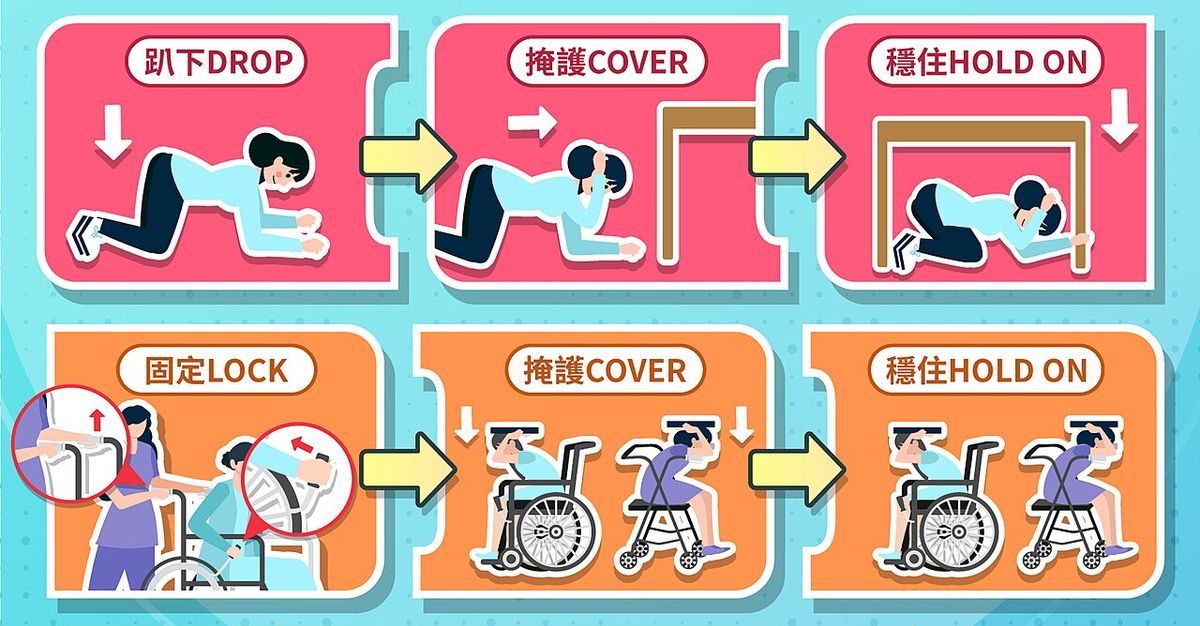
Photo: National Fire Agency, Ministry of the Interior via Wikimedia Commons, Attribution (Open Government Data License)
- At home: get under a sturdy table and hold a leg. No table? Crouch next to an inside wall, away from windows, and cover your head and neck. In bed at night, stay there and put a pillow over your head.
- Don't run outside. In Taipei the danger outside is falling tiles, signboards and AC units from older buildings. Run out only if you are already on the ground floor right by an open door.
- Old walk-up (公寓): do not use the stairwell while it is shaking. Wait until it stops, then go down if you need to.
- High-rise: expect a long, slow sway. Stay put; modern towers are designed to move.
- Elevator: press every floor button and get out at the first floor that opens. If it stops between floors, press the emergency call button. After the quake, use stairs only.
- On the MRT: hold a pole and stay in the car. Trains stop or slow automatically and run to the next station. Do not pull the door release or step onto the track.
- On the street: move away from buildings toward an open space like a park or school field. In arcades (騎樓), shelter close to a thick column, not under the facade edge.
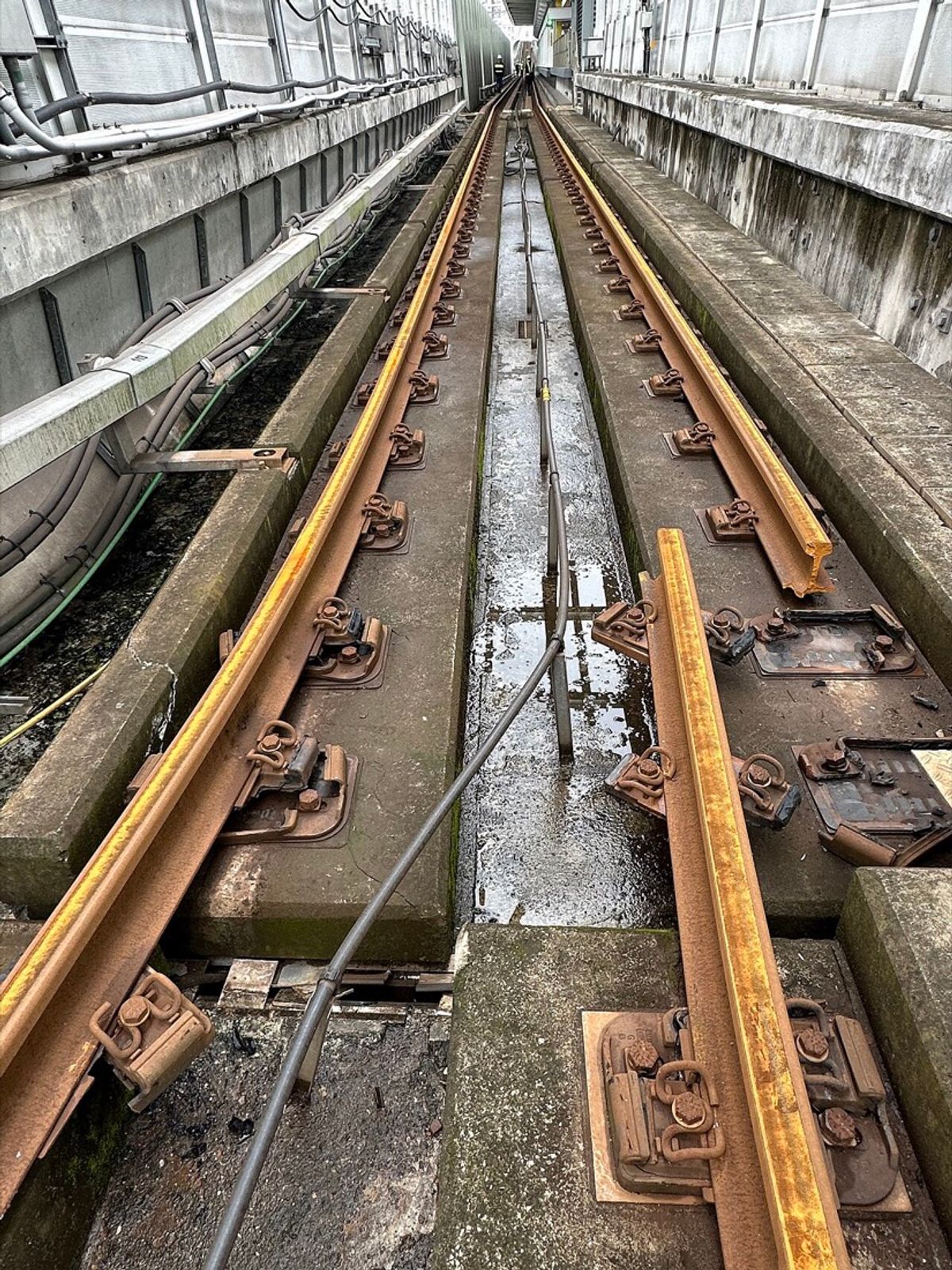
Photo: Department of Rapid Transit Systems, New Taipei City Government via Wikimedia Commons, Attribution
After it stops
1. Shoes on before you walk. Broken glass is the most common injury.
2. Gas. If you smell gas, close the valve on your water heater or bottled gas, open the windows, don't flip switches, and leave. Call 119 from outside.
3. Expect aftershocks. The 2024 quake had more than 1,700. A strong one within the first hour is normal.
4. Check the walls. Hairline cracks in plaster are common and cosmetic. Diagonal "X" cracks on concrete walls or columns, or doors that suddenly won't close, are worth photographing and sending to your landlord the same day. One Forumosa member was still repairing their Taipei building two years after 2024.
Our emergency numbers guide covers what to say on the phone in Chinese.
Your building matters more than anything you do
The 1999 Chi-Chi (921) earthquake killed about 2,400 people and led to stricter seismic codes, with further updates in 2005 and 2022 (the 2022 revision specifically targeted weak ground floors). The government uses December 31, 1999 as its cut-off: private homes with a building permit issued on or before that date qualify for a fully subsidized preliminary seismic check.
How to check your building's age:
- Rental listings on 591 show 屋齡 (building age). A building completed in 2001 or later almost certainly had its permit after 1999.
- Ask the landlord for the building transcript (建物謄本), which lists the completion date (建築完成日期).
Red flags in older buildings:
- Soft story: a ground floor of open shopfronts or a parking garage with few walls, carrying four or more floors of apartments. That is the Uranus Building pattern.
- Illegal rooftop additions (頂樓加蓋) adding weight on top.
Our pick: for a long lease, choose a building from 2000 or later, ideally an elevator building with a management office. If you love an older walk-up, look for one with solid walls on the ground floor and no heavy rooftop addition, and avoid the top floor. Our guide on walk-up vs elevator buildings and our humidity, mold and typhoons checklist cover the rest of a viewing. You can also look up soil liquefaction risk for any address on the government's map at liquefaction.gsmma.gov.tw.
Insurance: what covers what
Residential Earthquake Basic Insurance (住宅地震基本保險) is attached to the owner's home fire insurance. For about NT$1,350 a year it pays up to NT$1.5 million if the building is a total loss, plus up to NT$200,000 for temporary housing. Since July 15, 2025, homes that get a red "dangerous" placard but are not a total loss can also claim NT$100,000 for temporary housing. It covers the building and the policyholder, which means the owner, not you.
Your own laptop and furniture are not covered. Ask an insurer about contents insurance (住宅動產火災保險) with an earthquake add-on.
The kit: overlap it with your typhoon prep
You already need most of this for typhoon days, so build one bag:
- Water: 3 liters per person per day for 3 days
- Food that needs no cooking
- Flashlight or headlamp, plus a charged power bank
- Cash in small bills (card readers go down with the power)
- Medicines, glasses, a basic first aid kit
- Photos of your passport, ARC and NHI card on your phone, and paper copies in the bag
- Your address written in Chinese
- Whistle, gloves, slippers or old shoes under the bed
Finally, strap tall bookcases and wardrobes to the wall with L-brackets from IKEA or any hardware store (五金行). That five-minute job prevents more injuries than anything else here.